

Data Exploration
WorkFlow
Python Analysis
SQL - Import the data
SQL Analysis
SQL - Screenshot
Data Exploration
Data & Columns Definitions
Tables:
- Dim_Products.csv
- Dim_Customers.csv
- Fact_Sales:
- Sales_Data_2022.csv
- Sales_Data_2021.csv
- Sales_Data_2020.csv
WorkFlow
The Work Flow
- Import and clean the data.
- Analyze and plot the data (answer business questions).
Python Analysis
SQL - Import the data
-- CREATE ORDERS TABLE
CREATE TABLE orders
(
order_date timestamp,
stock_date timestamp,
order_number character varying,
product_key numeric,
customer_key numeric,
territory_key numeric,
orderline_item numeric,
order_quantity numeric
);-- IMPORT DATA TO TABLE ORDERS
-- 2020 sales data
COPY
orders
FROM
'D:/chichiumelo.com.ng/portfolio/Sales and Customer Analysis - SQL/dataset/Fact_Sales/ArizonaBikes_Sales_2020.csv'
WITH (FORMAT CSV, HEADER true, DELIMITER ',');

-- 2021 sales data
COPY
orders
FROM
'D:/chichiumelo.com.ng/portfolio/Sales and Customer Analysis - SQL/dataset/Fact_Sales/ArizonaBikes_Sales_2021.csv'
WITH (FORMAT CSV, HEADER true, DELIMITER ',');

-- 2022 sales data
COPY
orders
FROM
'D:/chichiumelo.com.ng/portfolio/Sales and Customer Analysis - SQL/dataset/Fact_Sales/ArizonaBikes_Sales_2022.csv'
WITH (FORMAT CSV, HEADER true, DELIMITER ',');

SELECT * FROM orders;

-- CREATE PRODUCTS TABLE
CREATE TABLE products
(
product_key numeric,
product_name character varying,
product_cost numeric,
product_price numeric
);

-- IMPORT PRODUCT DATA
COPY
products
FROM
'D:/chichiumelo.com.ng/portfolio/Sales and Customer Analysis - SQL/dataset/Dim_Product.csv'
WITH (FORMAT CSV, HEADER true, DELIMITER ',');

SELECT * FROM products;

-- CREATE CUSTOMER TABLE
CREATE TABLE customers
(
customer_key numeric,
prefix text,
first_name text,
last_name text,
birth_date timestamp,
marital_status text ,
gender text ,
email character varying,
annual_income numeric
);

-- IMPORT CUSTOMER DATA
COPY
customers
FROM
'D:/chichiumelo.com.ng/portfolio/Sales and Customer Analysis - SQL/dataset/Dim_Customer.csv'
WITH (FORMAT CSV, HEADER true, DELIMITER ',', ENCODING 'WIN1252'); -- got encoding error wth UTF-8

SELECT * FROM customers;
SQL Analysis
'''
Management would like to analyze their sales and customer data to improve marketing, customer relationships, and revenue.They need answers to the following questions:
1. What year/month generated the most revenue, so they can replicate campaigns and other factors that led to high sales?
2. What products are selling the most in volume and what is their comparison to profits, so they can increase profit margins for high selling volumes with low profits?
3. Which customers are in the bottom 25% based on sales, so they can improve on follow-up and email campaigns to those customers?
'''-- Before we start answering the questions, we would check if all sales data was imported then, we would create a view to hold all sales,
-- products and customer data-- Check that all year's sales were imported into the orders table
SELECT DISTINCT(EXTRACT(YEAR FROM order_date))
FROM orders;

-- We would create a view to hold all sales for products and customers
CREATE VIEW all_sales_vw AS
SELECT
order_date,
EXTRACT(YEAR FROM order_date) as order_year,
EXTRACT(MONTH FROM order_date) as order_month,
order_number,
p.product_key,
product_name,
c.customer_key,
concat(first_name,' ',last_name) as customer_name,
email as customer_email,
order_quantity,
p.product_cost * o.order_quantity as costs,
p.product_price * o.order_quantity as revenue
FROM orders o
LEFT JOIN products p ON o.product_key = p.product_key
LEFT JOIN customers c ON o.customer_key = c.customer_key;

SELECT * FROM all_sales_vw;

-- 1. What year/month generated the most revenue?
SELECT
order_year,
order_month,
round(sum(revenue),2) as total_revenue
FROM
all_sales_vw
GROUP BY
order_year,
order_month
ORDER BY total_revenue desc;

--- June 2022 generated the highest revenue with $1,826,987.14

-- 2. What products are selling the most in volume and what is their comparison to profits?
SELECT
product_name,
sum(order_quantity) as volume,
sum(revenue - costs) as profits
FROM
all_sales_vw
GROUP BY
product_name
ORDER BY volume desc
LIMIT 10;

-- Water Bottle- 30oz has the highest volume with 7967 and a profit of $24,886.5179

-- 3. Which customers are in the bottom 25% based on sales?

CREATE VIEW bottom25_customers AS
WITH customer_sales AS
(
SELECT
customer_name,
customer_email,
sum(revenue) as revenue
FROM
all_sales_vw
GROUP BY
customer_name,
customer_email
)

SELECT
customer_name,
customer_email
FROM
(
SELECT *,
NTILE(4) OVER(ORDER BY revenue) as customer_group
FROM customer_sales
)x
WHERE x.customer_group = 4

SELECT * FROM bottom25_customers;

-- There are 4354 customers in the bottom 25% that would require more follow-up and email marketing
SQL - Screenshot
Create a View for all sales
1- What year-month generated the most revenue?

2-What products are selling the most and what is their comparison to profits?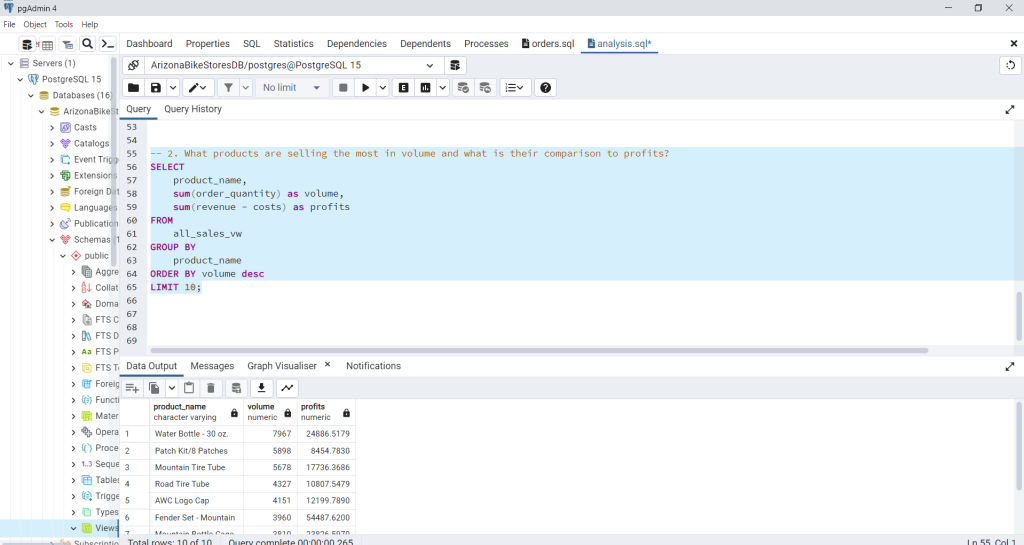

3- Which customers are in the bottom 25% of revenue?

Please note that there is a slight difference from the Python analysis figure for question 3 because customer gender wasn’t added in the initial all_sales_vw and the final CTE.